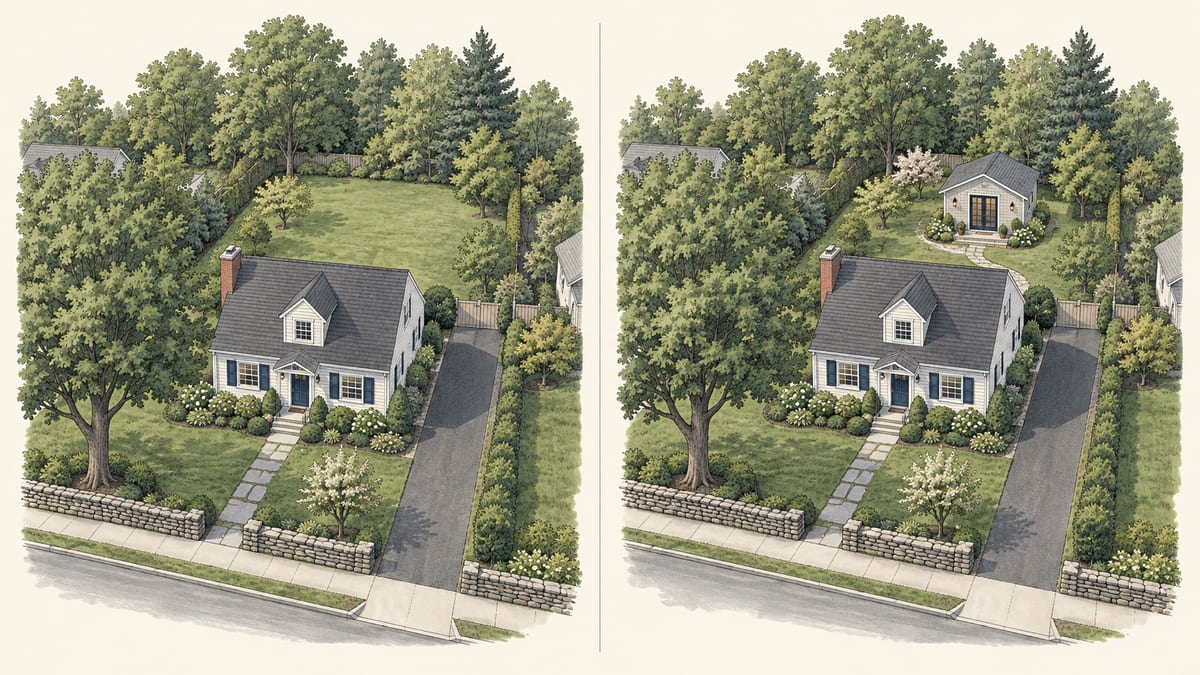
Renovation Line of Credit for an ADU: Borrowing on Future Value
Some renovation financing considers the property's projected value after eligible work is complete. Learn what to ask about appraisal, loan limits, draw requirements and the effect on an existing mortgage before relying on that approach for an ADU. Start with our financing guide for the full overview.
By the CT ADU team•Updated October 7, 2026•8 min read
The Short Answer
A renovation line of credit is a lender-specific product description. Some programs may consider after-renovation value (ARV), but that is not guaranteed by the name. Confirm whether the program finances your proposed ADU, how it calculates the credit limit, and whether it adds to or replaces your first mortgage. For a closer comparison, read our guide to HELOCs and home equity loans.
Appraisal support, project eligibility, borrower qualifications, draw requirements and repayment terms vary by program. Do not assume the ADU adds its construction cost to the home's value. CT ADU provides educational guides and calculators for planning. You can also review ADU financing options as you plan.
Current or as-completed value, depending on the program.
Considerations
Current equity, proposed improvements and appraisal support; confirm whether the first mortgage stays in place.
Lien Position
Confirm whether it adds a second lien or replaces existing financing.
Watch Out
Program-specific rules; construction cost does not establish added appraisal value.
Needs
Programs using future value typically require an as-completed appraisal.
Best Next Step
Estimate your ARV borrowing power below
What a renovation line of credit actually is
A standard HELOC uses available home equity. Some renovation financing considers projected as-completed value, supported by an appraisal and the program's project requirements. Compare the actual product terms; a renovation label alone does not establish how borrowing capacity is calculated.
Ask whether the financing is a second lien that leaves the first mortgage in place or a new mortgage that replaces it. Confirm the combined payments and total costs.
How after-renovation value (ARV) works
After-renovation value (ARV) is what your property is expected to appraise for once the ADU is finished — supported by an as-completed or after-renovation appraisal rather than a snapshot of today. A future-value program may let you borrow up to a set percentage of that ARV, minus the balance you still owe on your first mortgage.
Do not assume an ADU increases the appraisal by its construction cost. The appraiser evaluates the proposed work, and the program determines how that value affects its limits. The calculator below uses editable hypothetical assumptions, including rates and lending limits; those inputs are not current loan terms or a statement that a program is available.
Sources and further reading: CFPB: HELOCs; CFPB: home equity loans. Confirm current requirements with the relevant program or qualified adviser.
CT ADU · Renovation Line Calculator
How much can future value unlock?
Compare hypothetical current-value and after-renovation-value scenarios. A program may use either basis; these inputs do not establish available loan terms or eligibility.
$1,000,000
Your home's appraised value today.
$750,000
What you still owe on your first mortgage.
$300,000
Total build cost you need to finance.
$220,000
A planning assumption for the change in appraised value. Construction cost does not establish added value.
6.500%
Illustrative rate for planning; confirm the actual rate and repayment terms.
20 yrs
Lending limits (advanced)
90%
Illustrative combined loan-to-value assumption. Confirm any program limit.
80%
Illustrative current-value loan-to-value assumption. Confirm any program limit.
Future valueTest scenario
Hypothetical future-value scenario
Modeled borrowing amount
$348,000
90% of after-renovation value $1,220,000, minus your mortgage balance.
Meets entered cost in this scenario
Today's equity
Hypothetical current-equity scenario
Modeled borrowing amount
$50,000
80% of current home value $1,000,000, minus your mortgage balance.
Scenario gap: $250,000
Difference between these borrowing scenarios
This comparison changes two assumptions: the value basis and the loan-to-value limit (90% vs 80% by default).
+$298,000
At the default inputs, $176,000 comes from the value increase at 80% LTV, plus $122,000 from the extra 10 LTV points: a $298,000 difference. These are borrowing scenarios, not loan approvals.
After-renovation value
$1,220,000
Today's value + value the ADU adds
Modeled amortizing payment
$2,236.72
On $300,000 over 20 yrs; excludes fees and interest-only draw periods
Estimates for planning only — not a loan offer, appraisal, or guarantee. Actual after-renovation value, loan-to-value limits, rates, and eligibility vary by lender, property, and borrower. CT ADU is not a lender.
Future-value borrowing isn't the only path — it's one of a few that behave differently once construction starts. Here's how the renovation line sits against its closest cousins.
Option
Lends against
Watch out
Renovation line of credit
Current or after-renovation value, depending on the program
Program-specific rules; future-value products typically require an as-completed appraisal
Standard HELOC
Current value & existing equity
Capped by today's value; usually variable rate
Construction / renovation loan
Often completed project value, with staged draws
More documentation, inspections, and process
Compare appraisal basis, lien position, draw rules, fees and repayment across the actual programs available to you. A future-value approach is not automatically cheaper or more suitable, and it may not leave an existing mortgage in place.
Questions about financing on future value?
Use our educational financing resources to prepare questions about appraisal, program eligibility and repayment.
Consider how the program handles current equity, as-completed value, the existing mortgage and the timing of construction costs. Those factors help frame a comparison; they do not establish that a particular product fits your circumstances.
Compare the full cost and requirements with other eligible options. If the supported appraisal or approved loan limit is lower than an illustration assumes, you may need more cash or a different project scope.
Compare: current equity, supported as-completed value, repayment capacity and lien position.
Check alternatives: rates, fees, draw rules, project requirements and total repayment costs.
Reality check: an appraisal is not a construction-cost reimbursement; do not assume cost equals added value.
What to ask a lender before you apply
Do you lend against current value or after-renovation value (ARV)?
What's the maximum combined loan-to-value on a future-value line?
Is this a second lien, or would it replace my first mortgage?
Do you require an as-completed / after-renovation appraisal, and who orders it?
Fixed or variable rate — and if variable, what's the cap?
Can funds be drawn in stages as construction progresses?
How CT ADU helps
CT ADU reviews your property and goals to identify site and design questions. Our financing guides and calculators explain planning concepts so you can prepare for a separate discussion of loan terms and eligibility.
Start with the project, then the loan
Want an introduction? We can connect you with vetted lenders, including some that consider after-renovation value. CT ADU isn't a lender and isn't paid by lenders. Introductions are optional.
This guide is general information, not a loan offer, appraisal or financial advice. CT ADU is not a lender or mortgage broker. Loan availability, rates, terms, loan limits, appraisal treatment and underwriting vary by program, property and borrower. Confirm all details with a licensed lender before applying.
Frequently asked questions
Common questions about renovation lines and future-value financing.
What is a renovation line of credit?
The term describes a lender-specific renovation financing product. Some programs may consider projected as-completed value, while others use current value. Confirm eligible work, appraisal basis, lien position, draw requirements and repayment terms; the name alone does not establish additional borrowing capacity.
How is a renovation line of credit different from a HELOC?
A standard HELOC uses available home equity. Some renovation programs may consider projected as-completed value and impose project-specific draw and inspection requirements. Confirm the terms and lien position rather than assuming both products work the same way.
What is after-renovation value (ARV)?
ARV is the projected appraised value after planned improvements are complete. A program that considers this value may use an as-completed appraisal. The appraisal is not a guarantee of resale value, and construction cost does not establish the amount of value added.
How much can I borrow with a renovation line of credit?
The amount depends on the program's valuation basis, existing secured debt, loan-to-value limits and borrower qualifications. A program using future value may base its limit on a percentage of as-completed appraised value, less existing debt. Confirm the actual calculation; a planning estimate is not an offer.
Is a renovation line of credit available in Connecticut?
Availability is lender- and program-specific and has not been established for any individual property by this guide. Ask whether the lender currently offers an eligible product for your proposed Connecticut ADU, including its appraisal, lien-position and project requirements.
Do I keep my first mortgage with a renovation line of credit?
Some products add a second lien, while others may replace existing financing. Confirm the specific structure before assuming your current first mortgage and its terms will remain in place.
Updated October 7, 2026. Appraisal, lien-position and project requirements vary by program. Confirm current details with the lender and relevant professionals before relying on an estimate.